

Readers may recall a recent piece on cinema, Spain and Cuba. You were intrigued. Here’s another piece by the same guest writer. Enjoy! Ed.
*** ***
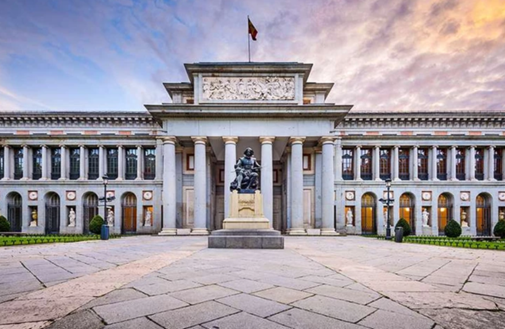 | “El Prado: Does it really confront Spain’s violent past?” A short analysis by Alice Quirk, B.A. (Hons 1st class) |
During this essay I will analyse how El Prado’s current exhibition, Uninvited Guests: Episodes on Women, Ideology and the Visual Arts in Spain (1833-1931), confronts Spain’s traumatic past. The exhibition uses recurrent motifs to address the inferior position of women in a patriarchal society, who were confined to domesticated roles. These strong motifs have been extremely effective in engaging the public by making them reflect upon the treatment of women, permitting a confrontation of a traumatic past. I will explore how composition, paintings and recurrent motifs of the exhibition are effective.
Fewer than half the paintings within this exhibition are by female artists, which makes you ask ‘Why not more?’. This composition has attracted criticism from art critics. Rocio de la Villa has accused El Prado of recreating the misogyny of the 19th century (Villa, 2020). To some extent I feel it has been recreated, but for an intentional artistic purpose – to precisely portray the past and show how women in the art industry were underrepresented and their capabilities restricted. Carol Duncan explains ‘To control a museum means precisely to control the representation of a community and its highest values and truths’ (Duncan, 1995). This ratio split could be said to confront Spain’s traumatic past of said underrepresentation, since the mirroring in the exhibition highlights the social matter to its audience – forcing them to contemplate it. On the other hand, it could be argued that the exhibition does not confront a traumatic past because it doesn’t fully represent Spanish society as fewer female paintings are included, so we’re unable to see society from the female perspective. Some would dispute that an exhibition with greater representation of female artists would challenge the societal norms of Spain’s traumatic past, which would be a more active confrontation. However, I think the quantity of paintings by females in this exhibition does not dilute the messages conveyed by the paintings that are included. It could also be argued the exhibition does not serve to recreate the misogyny because the paintings pay tribute to female artists who were previously denied wider acknowledgment.
Furthermore, of the female paintings included in the exhibition, the majority are either: still-life or recreations of paintings originally by male artists. Paintings of flowers and fruits were ‘associated with certain qualities and virtues regarded as feminine, like powers of observation, minuteness, delicacy, domesticity, and even chastity’ (El Prado, 2020). This displays the disturbing past as it shows how women’s artistic capabilities were capped and also reflects the common held view of the little perceived value in educating females. This was applied as a tool to inhibit the progress of females and perpetuate their lower standing in society. However, without the context provided in the exhibition the link between women producing still life paintings and inequality could be overlooked, and someone could therefore argue that this exhibition doesn’t confront the traumatic past. This highlights the importance of context, which I will further discuss.
The paintings in the exhibition are accompanied by descriptions which educate the public to their context. Moreover, under these exceptional circumstances the Museum has had to adapt and expand the coverage of its online resources, making the context of the exhibition more widely available. Compared to the Museum’s performance during the 1990s, where ‘signs and labels were totally inadequate’ (Holo, 1999), this is a significant improvement. In order to confront the past, it is necessary to be fully exposed to it. By providing background information on the paintings, the past is given more visibility and it allows the public to grasp more from the exhibition and leave feeling enlightened. Where previously, it was ‘almost impossible to glean anything beyond the most rudimentary information’ (Holo, 1999), it is now possible to address more complex themes running through the paintings.
Some of the Artists included within the exhibition are known for their social realist style, such as Antonio Fillol and are therefore critical of the past. Both his paintings La Rebelde and El sátiro depict females who experience abuse at the hands of men. El Sátiro, portraying a young girl identifying her abuser, strongly contrasts with the Crisálida of a female child nude by Perdro Sáenz. This painting was deemed acceptable at the time, as it was influenced by hygienist theories which explored ‘the topic of the awakening of sexual maturity’ (El Prado, 2020). Both these paintings illustrate how from an early age females were sexualised by men. I think the inclusion of the Crisálida in the exhibition draws the observers’ attention to confront Spain’s traumatic past, as it evokes shock and discomfort and emphasises the gap between what was, and what is now socially acceptable.
The painting by María Luisa Puiggner’s painting, ‘Una Joya’, confronts the problems and misconceptions of the past. ‘Una Joya’ pictures a young mother dressed in mourning clothes cradling a baby as she pawns off her jewellery. This painting contemplates the dependence of women upon male figures. This artist defied the commonly held belief that females didn’t have the capacity or awareness to consider social problems. Moreover, the progression and recognition her work received was largely due to how she signed her paintings without her first name, so that the public assumed she was a male artist. When her true identity was known, ‘her work was forgotten’ (El Prado, 2020). The inclusion of this painting confronts the past in two ways: it’s extremely insightful of gender disparity, as the progression of her career was so tightly entwined to her gender, and the theme in the painting addresses the economic dependence of females upon males.
Left without male figures, women were forced to resort to alternative methods in order to support themselves and their families and these methods are explored especially in section four of this exhibition. La Bestia Humana, by Antonio Fillol, shows the troubling past of how females were forced, by circumstances, into prostitution. Prostitution is a recurrent motif and exposes a traumatic past that women had to negotiate. Their choices were few.
In contrast, the ideal woman was expected to be a good wife and mother. The painting, El precio de una madre, by Marceliano Santa María, illustrates two mothers of different social standing. One a villager, her gaze fixed on her own child whilst she holds the child of the more privileged woman. Many wet nurses had to leave their homes and families to work for wealthier families. This confronts Spain’s traumatic past through reflection on the hierarchical structures of the past and the trauma of inequality.
Paintings such as the Después del baño, demonstrate how women were perceived as objects for male satisfaction. This nude painting of a woman lying on a sofa changing her clothes was intended for the male gaze. This is therefore confronts the traumatic past as the observers of the exhibition see how females were objectified by men and valued for their beauty.
In conclusion, the confrontation of a traumatic past is achieved by the use of resources provided in the exhibition, which explain the context of the paintings and allow the public to see the recurrent motifs present in the paintings. Furthermore, Mieke Bal explains in Thinking about Exhibitions a painting is ‘charged with cultural meaning which can tell us something of the culture in which it was made’ (Bruce W. Ferguson, 1996). This link to culture allows past traumas to be visible. The exhibition has acted as a microcosm of Spanish culture by addressing recurrent motifs of abuse, inequality and objectifying of women, which reflect the traumatic past. The themes and structure of the exhibition have engaged the public, which allows an active confrontation of the past.
Bibliography
Bruce W. Ferguson, R. G. S. N. a. R. G., 1996. Thinking about exhibitions. s.l.:s.n.
Duncan, C., 1995. Civilizing Rituals. s.l.:s.n.
El Prado, 2020. Crisálida. [Online]
Available at: https://www.museodelprado.es/coleccion/obra-de-arte/crisalida/7311a89b-8805-47cc-940f-56b94585bb8f
[Accessed 20 November 2020].
El Prado, 2020. SECCIÓN 17. ANFITRIONAS DE SÍ MISMAS. [Online]
Available at: https://www.museodelprado.es/en/whats-on/multimedia/uninvited-guests-resources-for-the-visit/b63d18a1-246f-49dc-d350-a8e26c944b16?n=19#galeria
[Accessed 2020 November 2020].
El Prado, 2020. Uninvited Guests Guide. [Online]
Available at: https://content3.cdnprado.net/doclinks/pdf/visita/uninvited-guests-guide.pdf
[Accessed 20 November 2020].
Holo, S. R., 1999. Beyond the Prado: Museums and Identity in Democratic Spain. s.l.:s.n.
Jones, S., 2020. theguardian. [Online]
Available at: https://www.theguardian.com/world/2020/oct/19/prados-first-post-lockdown-show-reignites-debate-over-misogyny
[Accessed 21 11 2020].
Villa, R. d. l., 2020. Las Rechazadas del siglo XIX. [Online]
Available at: https://elcultural.com/las-rechazadas-del-siglo-xix
[Accessed 27 November 2020].

 Artifex Antiquus: welcome to all